
Two Supplier Quotes Are Comparable Only After the Scope Matches
Compare the complete lunchware order: product construction, included accessories, packaging, testing, tooling, timing and delivery responsibilities.
- Published
- Updated
- Author
- ANTUER
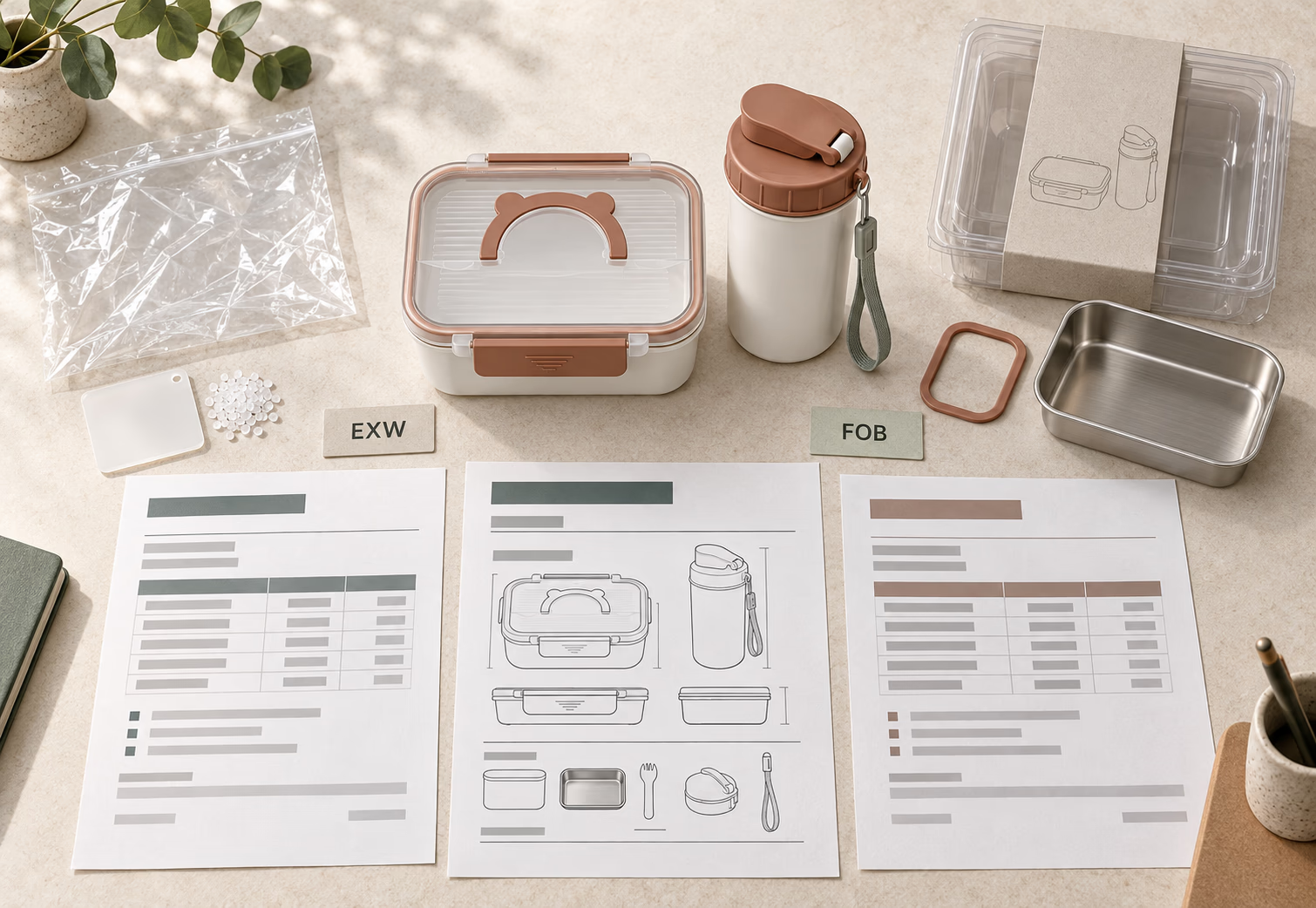
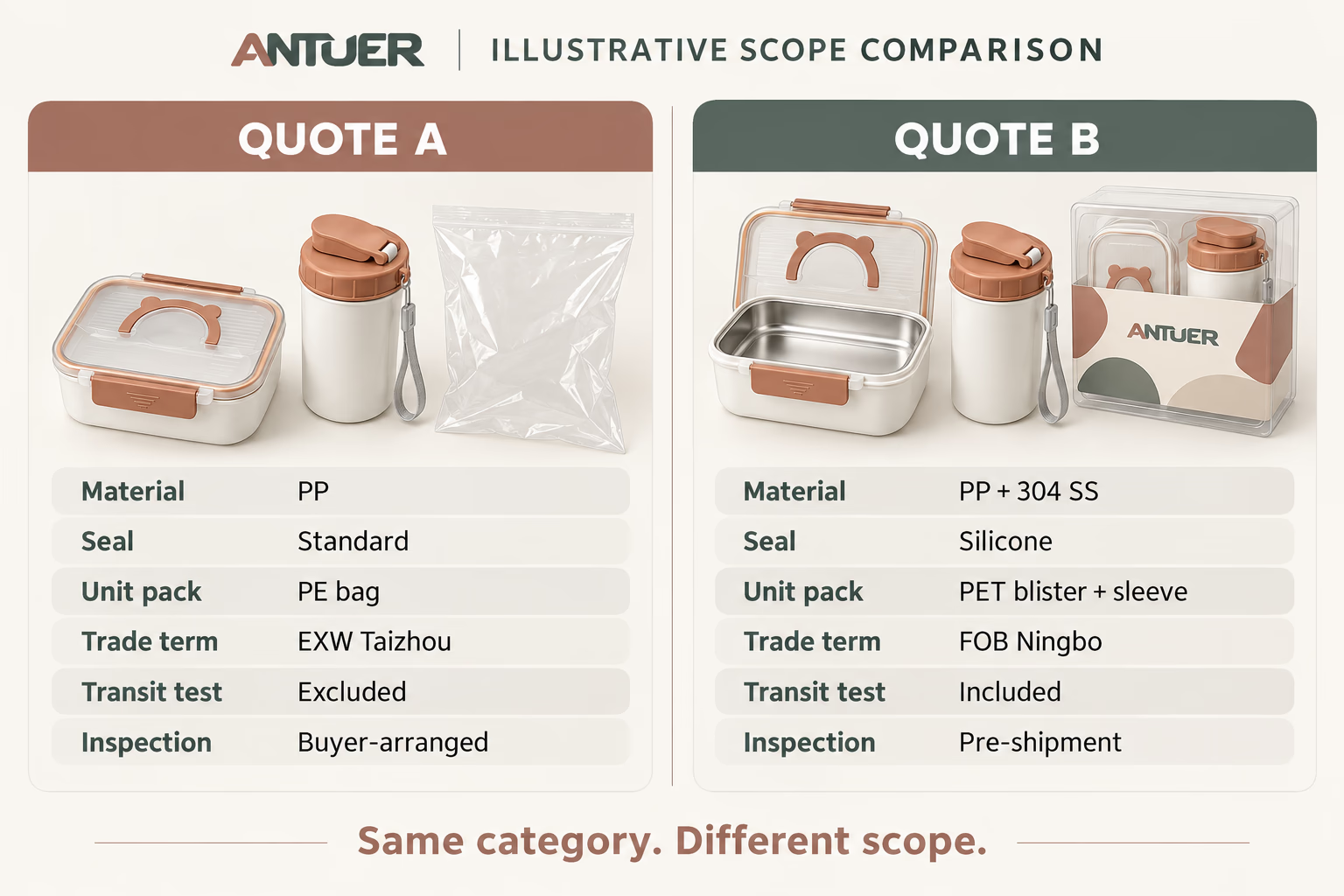
Imagine two quotations for a lunch box that looks almost identical in the photographs. One includes utensils, a printed retail box and inspection. The other prices only the container in a plain bag. The lower unit price is easy to spot; the cost of making both offers meet your brief is not.
For a brand, importer or wholesaler, the useful question is: what will it cost to receive the same sellable set, with the same evidence and delivery responsibilities?
Start by making the differences visible. Then decide which differences are worth paying for.
Issue one controlled RFQ package
Send each supplier the same dated request for quotation (RFQ). A workable first version identifies:
- the model or drawing, intended meal and destination market;
- component materials, critical dimensions and the complete supplied set;
- quantity by model, color and packaging version;
- branding, retail packaging and shipment packing;
- required samples, tests and inspection;
- delivery point, currency and target date.
Ask suppliers to mark each requirement as included, excluded or offered as an alternative. Leave an unresolved cost marked “pending”; a blank cell can otherwise look like a zero.
If the structure is still undecided, use the lunch box selection guide first. Comparing different meal formats is a product decision; comparing suppliers becomes useful once the essential requirements are shared.
Normalize the product before the price
Compare the components, not only the main image. Two similar-looking boxes may use different closures, seals, inserts or accessory sets. Those differences can change how the customer packs, carries and cleans the product.
Use a short comparison sheet:
| Question | Evidence to request |
|---|---|
| Is it the same set? | Component list and an identified sample |
| Does it hold the intended meal? | Usable compartment dimensions and capacity basis |
| Is the construction equivalent? | Materials by component and agreed critical dimensions |
| Is the branding equivalent? | Process, size, position and number of print colors |
| Can the quantity be split as planned? | Minimum quantities by model, color and pack version |
A different construction may be a better choice. Keep it as a clearly described alternative so the saving and the compromise can be assessed together.
Put compliance and testing inside the quote
“Food grade” does not tell you what documentation or testing the price includes. Ask which construction, colors, intended use and destination market the proposed evidence covers. Agree who arranges and pays for the initial assessment, any justified additional testing and reinspection after a failure.
For packaging, “drop test included” also needs a method, product-package configuration and acceptance criteria. ISTA distinguishes tests with different purposes; selecting a screening test is a different decision from selecting a distribution simulation.[1]
Put the document delivery date in the approval plan. A report that arrives after the packaging is printed may leave a claim unresolved at the wrong moment.
Compare tooling and customization across the project life
Separate recurring product costs from one-time development costs. For any new mold or fixture, clarify ownership, permitted use, trial rounds, maintenance and the process for later modifications or transfer.
Then compare the first order and a realistic reorder separately. A tooling charge spread over an optimistic lifetime forecast can make the first purchase look cheaper than the cash it actually requires. Show the initial payment as well as any allocation used in your comparison.
If your must-haves fit an existing model, ask for that route alongside new development. The private-label customization guide helps define which changes belong in each proposal.
Make packaging and quality scope measurable
Confirm the individual package, inserts, instructions, barcode labels, units per master carton and carton dimensions. Ask whether the quoted pack protects the complete set and suits the sales channel.
For example, including utensils changes both the sellable set and the packing task. A quoted retail box may still leave accessory restraint or an instruction leaflet unpriced.
For quality control, record:
- the approved production reference and critical checks;
- in-process checks and final inspection arrangements;
- functional tests and the agreed sampling plan;
- responsibility for sorting, rework and reinspection;
- records to accompany the shipment.
Agree how failures will be handled before the goods are ready. “Inspection included” has little commercial value if neither party knows who pays when a lot needs rework.
Name the Incoterms rule and named place
Incoterms® 2020 allocates delivery-related obligations, costs and risk between seller and buyer.[2] It does not define the product specification, payment terms or remedies for a defective order.[3]
Write the selected rule, exact named place or port and edition in the quote. Confirm the handover point and list origin, freight and destination charges against the responsible party. Bring offers using different rules to the same comparison point before ranking them.
Ask your logistics provider to verify charges outside the supplier's scope. Keep estimates dated and separate recoverable taxes from costs where relevant to your business.
Add timing and cash exposure
Ask what starts the lead time: deposit, sample approval, final artwork or another milestone. Include testing, packaging approval and inspection in the schedule.
A useful question is: “If the sample needs a change, which dates and payments move?” Also confirm quotation validity, payment stages, cancellation terms and any minimum material commitment.
This makes the comparison useful for the launch plan, rather than only for the purchasing spreadsheet.
Build a comparison with three totals
Show three views using the same order quantity:
- Comparable product cost: the agreed product and work included in its unit price.
- Ready-to-ship project cost: add separately priced development, packaging, tests, inspection and origin work.
- Delivered commercial scenario: add the remaining logistics, destination charges and applicable duties or taxes.
Mark which items are already included so nothing is counted twice. Keep confirmed costs, estimates and unresolved items distinct.
Buyer takeaway
Before negotiating the last price difference, ask both suppliers to return the same scope sheet with their exclusions marked. That gives you a concrete decision: which offer best fits the product, launch budget and delivery plan?
To discuss your quotation brief with ANTUER, send the selected format, quantity by version, destination and packing requirements. Identify any open choices so they can be priced as alternatives instead of hidden assumptions.
Sources
- ISTA Test ProceduresInternational Safe Transit Association
- Incoterms® 2020International Chamber of Commerce
- What the Incoterms® rules do and do not doInternational Chamber of Commerce
Related products
Formats to explore
Apply it to your project