
“Use AQL 2.5” Is Not a Quality Specification
Why a sampling plan can support lot decisions but cannot define what counts as a defect, which functions matter or how a product should be tested.
- Published
- Updated
- Author
- ANTUER
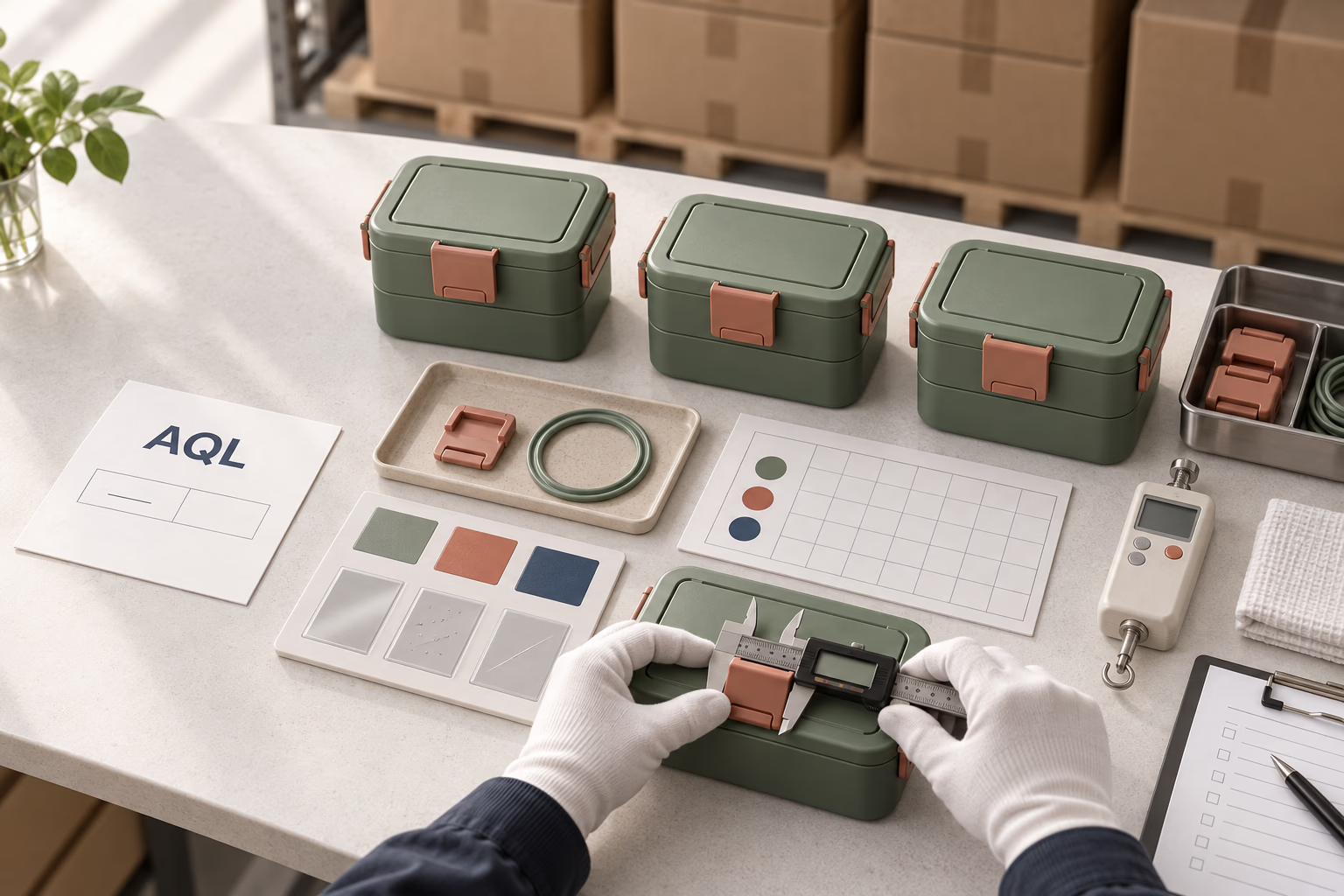
Imagine a shipment booked for next week. The purchase order says “AQL 2.5,” but the inspector and supplier disagree about whether a stiff lunch-box latch is acceptable. The buyer now has to settle the product requirement while also deciding whether to delay shipment.
The same gap appears in everyday inspection questions:
- Is a lid that closes with excessive force a major defect?
- How much color difference is acceptable?
- Is one drop of water after a leak test a failure?
- Which parts receive functional testing?
- Are scratches judged at 30 centimeters or under magnification?
An AQL number does not settle these questions. Agreeing on them before production makes a disputed inspection easier to resolve.
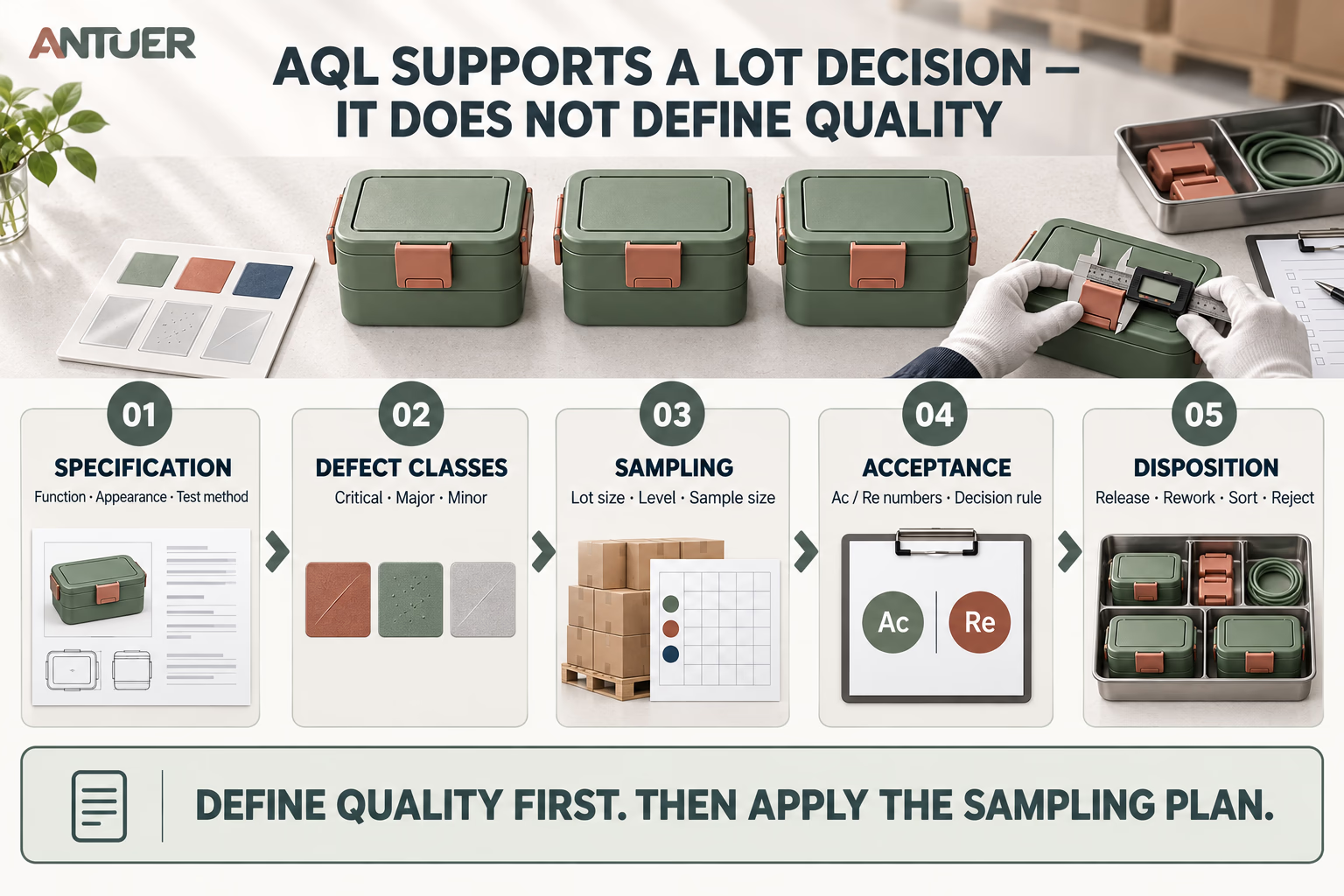
AQL belongs to a sampling system. It helps determine how a lot will be sampled and accepted or rejected after defects have been defined. It does not define the product, the test method or the seriousness of each failure.
Separate two decisions
Every final inspection needs two connected inputs:
- What is conforming? Product specifications, approved samples, test methods, visual standards and defect classifications answer this.
- How will the lot decision be made? The sampling scheme, inspection level, lot size, sample size and acceptance/rejection numbers answer this.
ISO 28590 gives an introduction to selecting attribute-sampling systems.[1] NIST explains that acceptance sampling uses sample results to decide a lot's disposition, rather than to measure its exact quality.[2] For an AQL-based lot-by-lot scheme, ISO's public catalogue lists ISO 2859-1:2026 as the published edition.[4] Name the agreed standard and edition in the inspection order; the inspection provider needs the applicable full standard to select and apply the plan, not an undated “AQL table.”
First settle which product and configuration you are buying. Our lunch-box selection guide helps turn intended use into the requirements the inspection will check.
AQL is not “the allowed percentage in the shipment”
Only part of the lot is inspected. NIST describes both the risk of rejecting acceptable-quality lots and the risk of accepting poor-quality lots.[3] A pass therefore does not prove that every unit works, or that the shipment contains no more than a fixed percentage of defects. A rejection does not measure the exact defect rate of every carton either.
The buyer should avoid consumer-facing or internal statements such as “AQL 2.5 guarantees 97.5% perfect goods.” That is not what the plan means.
Classify defects by consequence
Many inspection briefs use critical, major and minor classes. The names are only useful when examples and consequences are defined for the product and market.
For a food container, possible considerations include:
- Critical: a condition presenting an unacceptable safety or regulatory risk, such as a sharp accessible edge or prohibited contamination, according to the agreed definition.
- Major: a failure likely to make the product unusable, cause a return or materially depart from the sales promise, such as a latch that will not close or failure of an agreed leak test.
- Minor: an appearance or workmanship departure that does not materially reduce intended use, within the agreed visual boundary.
These are examples, not a universal classification. A scratch on a hidden underside and the same scratch across a premium front logo do not have identical commercial impact. A dimensional variation may be invisible yet prevent stacking or seal engagement.
Build a defect library with photographs, measured limits and decision notes. For example, document a latch that cannot engage, one that closes within the agreed handling requirement and one that exceeds it. Define the test setup and the classification before the inspector sees the shipment. Where appearance matters, show the viewing distance, lighting and product face being judged.
Also specify what is counted: defective units, individual defects or another basis required by the agreed plan. If one unit has a scratch and a failed latch, the inspector should not invent the counting rule during the inspection.
Sampling does not replace functional testing
Some checks are quick and non-destructive; others take time, require equipment or damage the sample. The inspection plan should say which sample receives which test.
For example:
- general workmanship on the full inspection sample;
- dimensions on a smaller, distributed subset;
- latch cycling on selected units from different cartons;
- leakage under a defined orientation, liquid, time and temperature;
- decoration rub or adhesion on a destructive-test subset;
- packaging checks across carton positions;
- barcode scan and content verification by SKU.
For each check, record the sample quantity, selection method, procedure, acceptance criterion and report field. A leak test on a smaller subset needs its own agreed decision rule; the result should not be described as if every piece in the visual sample had passed that test. Our leak-test planning guide covers the conditions that make that result interpretable.
Safety or compliance-critical characteristics may require controls beyond ordinary final sampling, such as supplier qualification, process validation, certificates tied to actual materials, in-process checks or more extensive testing. The appropriate approach depends on risk.
Inspect the lot that will actually ship
The lot must be clearly defined. Identify quantity, SKU, color, production window, packaging revision and location. Samples should be selected across the lot rather than offered from a convenient top layer.
For mixed products, decide whether each SKU is a separate lot or whether a justified stratified approach is used. Combining unlike colors or constructions can hide a localized problem. Also record replacements, rework and any units removed before sampling.
If a lot fails, hold its release and retain the report, photographs and identified failed samples. Agree on the affected scope, corrective action and any screening or rework before resubmission. Record which units were removed or corrected, then select a fresh inspection sample under the agreed resubmission rules. Reviewing only replacement units does not establish the status of the remaining shipment.
If a commercial deviation is proposed, record exactly what is accepted, for which quantity and order, and who approved it. A concession for one shipment should not silently become the quality target for the next. Any safety or legal issue needs its own resolution; a commercial signature cannot make an unsafe or noncompliant product acceptable.
A useful purchase-order quality package
Before production, align the following:
- current product specification and approved sample;
- market and intended-use requirements;
- defect list with critical/major/minor examples;
- test methods, equipment and conditioning;
- lot definition and sampling standard/version;
- inspection level and AQL values by defect class;
- handling of destructive tests;
- acceptance, rejection, rework and reinspection rules;
- report format and photographic evidence;
- authority to approve deviations.
Send the same package to the factory and inspection provider before the visit. Ask them to flag missing measurements or ambiguous examples while there is time to resolve them. This is a more useful pre-shipment safeguard than choosing a familiar AQL number alone.
Buyer takeaway
AQL can help manage inspection cost and lot risk. It cannot decide whether a weak latch, warped tray, color mismatch or leaking seal is acceptable. Define the product and its defects first; then apply an appropriate sampling rule consistently.
Sources
- ISO 28590:2017 — Introduction to the ISO 2859 SeriesInternational Organization for Standardization
- What Is Acceptance Sampling?National Institute of Standards and Technology
- Types of Lot Acceptance Sampling Plans and Risk TermsNational Institute of Standards and Technology
- ISO 2859-1:2026 — AQL-indexed sampling schemes for lot-by-lot inspectionInternational Organization for Standardization
Related products
Formats to explore
Apply it to your project