
The Shipping Carton Is Part of the Product: Damage, Empty Space and Margin
How importers and e-commerce sellers can review nesting, retail packs, master cartons and transport tests before a low unit price becomes a high landed cost.
- Published
- Updated
- Author
- ANTUER
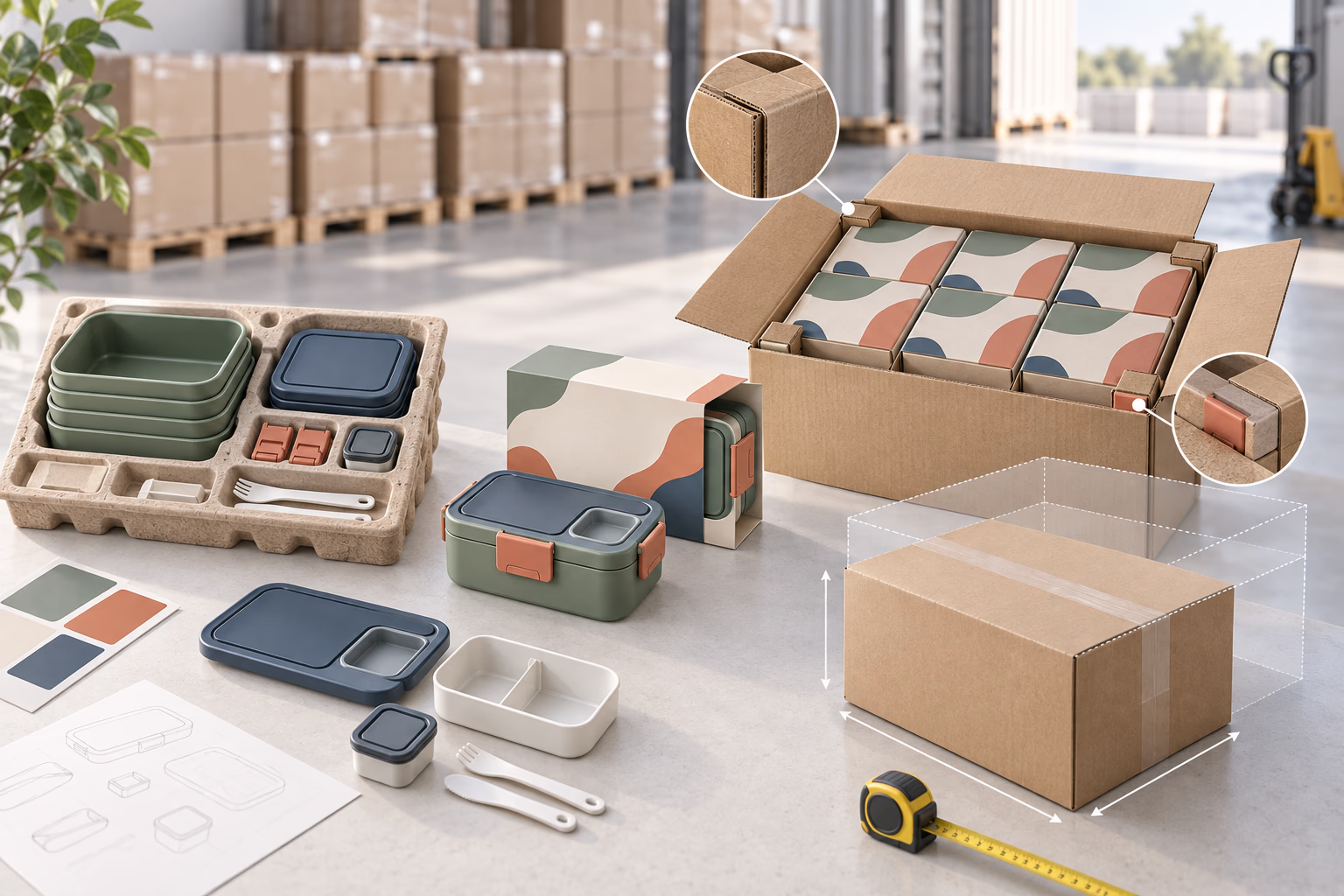
A lightweight organizer can be inexpensive at the factory and costly to ship. A lunch box can arrive with no structural break and still be unsellable because its clear lid is scratched or its latch is permanently stressed by the insert.
These are not separate “logistics problems.” For a buyer, the retail product includes the pack-out that carries it through a warehouse, pallet, parcel network and customer doorstep.
The right time to evaluate that system is before the final unit price and packaging artwork are approved.
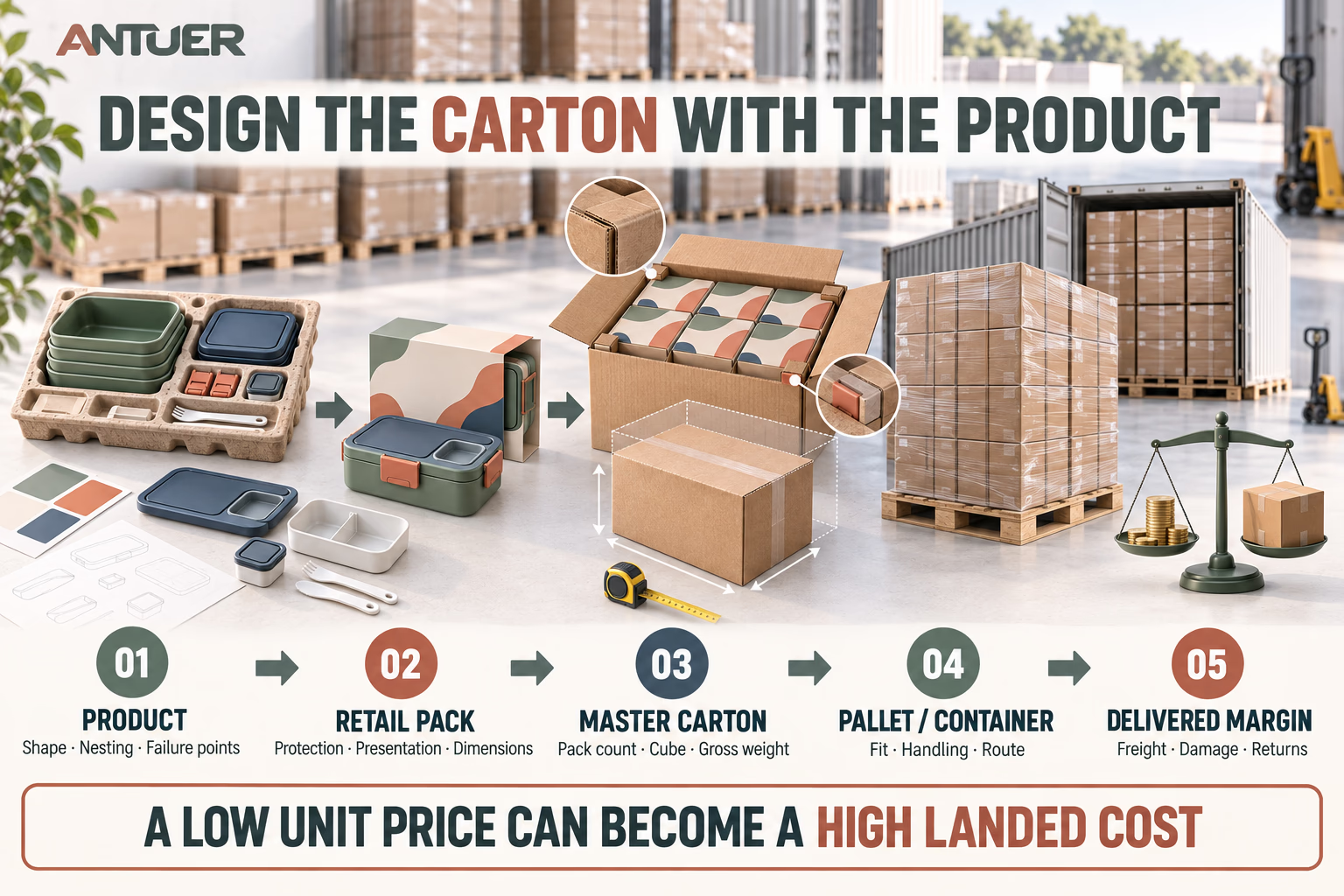
Low product weight does not guarantee low freight cost
Parcel carriers may use dimensional weight—the space occupied by a package relative to its mass—rather than actual weight alone. FedEx states that it charges the greater of dimensional or actual weight; UPS says dimensional weight may apply when a package is large relative to its weight.[1][2]
This is especially relevant to plastic houseware. Large bowls, carts, bins and lunch sets can enclose air. A decorative handle or non-nesting rim can increase carton dimensions. An extra centimeter may look small on one unit and become significant across an e-commerce case pack.
Ocean and road freight use different pricing structures, but carton volume still affects pallet and container utilization. Request the dimensions and gross weight of the closed, packed carton, then obtain a quote for the actual route and service. A smaller carton does not automatically reduce the invoice if another weight, minimum charge or handling rule determines the price.
Design the nesting strategy with the product
Nesting can reduce volume, but it introduces its own questions:
- Can units be separated without excessive force?
- Do surfaces rub and create visible marks?
- Can a latch, handle or wheel carry compression it was not designed for?
- Is a thin protective layer needed between clear or decorated parts?
- Does the nested stack remain stable during packing?
- Can workers reproduce the pack-out at production speed?
Ask the supplier to pack and unpack a complete case, not just show two units nested together. A stack that saves space but needs force to separate can create damage or extra warehouse work at destination. Compare the delivered arrangement with the way the retailer will sell it: nested bulk units may be practical for one channel, while individually boxed sets need a different calculation.
If structure is still open, include packing footprint in the lunch-box selection review. Discovering the problem after tooling or retail artwork approval leaves fewer inexpensive options.
Define what “damage” means before testing
A cracked product is an obvious failure. Other acceptance decisions are less obvious:
- a cosmetic scuff visible under retail lighting;
- a deformed retail box that still protects the item;
- a latch that works but has changed closing force;
- a lid that closes but no longer seals as intended;
- a label or barcode that becomes unreadable;
- a set whose components arrive mixed or incomplete.
ISTA advises defining acceptable product and packaging condition before the test.[3] Make the boundary visible: a marked reference photo for the lid, the required latch operation, a readable barcode and the complete accessory list. Decide separately whether a scuffed shipping carton is acceptable and whether the same mark on the retail box would prevent sale.
Match the test to the distribution route
The same retail pack can follow different journeys:
- full-carton wholesale on a pallet;
- retailer distribution center and store shelf;
- fulfillment center followed by parcel delivery;
- direct parcel shipment from seller to consumer;
- mixed-SKU export carton with repeated handling.
ISTA’s procedure families range from integrity screening to general and member-specific distribution simulations. Its 6-Amazon.com procedures are designed around defined e-commerce fulfillment systems.[4] Passing one procedure should not be presented as universal protection for every route.
Give the laboratory the actual route, handling configuration and product concerns. A master-carton result is useful for that tested arrangement; it does not establish that one retail unit can travel safely after the carton is split at a fulfillment center.
For Amazon Over Boxing, ISTA currently lists Project 6-AMAZON.COM-OB (26-26) for e-commerce fulfillment and parcel delivery.[5] Ask the laboratory to confirm that this route and the current channel requirements apply to your project. It is a specific distribution test, not a general regulation or a guarantee of compliance with every marketplace requirement.
Protect the failure points, not every empty space
Adding material everywhere may increase cost and dimensional weight without protecting the part that fails. Start by mapping the product:
- protruding latches and handles;
- transparent faces vulnerable to rubbing;
- thin corners and long unsupported spans;
- wheels, rails or drawer fronts;
- food-contact surfaces that must arrive clean;
- loose accessories that can strike the main product.
Then trial protection where loads and movement occur. For example, compare a divider that separates a loose utensil from a clear lid with a pack that simply adds filler around the set. Check rubbing, movement and unloading in each candidate before selecting one. The better option is the one that meets the agreed protection and packing requirements at an acceptable total cost; material appearance alone does not establish performance.
Put packaging data in the quotation comparison
For every shortlisted product, request:
- retail-pack dimensions and weight;
- pieces per master carton;
- master-carton outer dimensions, gross and net weight;
- nesting arrangement and protective materials;
- pallet pattern where relevant;
- expected container or vehicle loading based on confirmed pack-out;
- e-commerce over-box assumptions, if any;
- packaging test method, sample configuration and result;
- packaging-artwork and barcode position.
Normalize the data per sellable unit. As a calculation example, a 60 × 40 × 40 cm carton occupies 0.096 m³; at 24 sellable sets per carton, that is 0.004 m³ per set before pallet and loading losses. Compare another pack-out on the same basis. A smaller carton containing fewer sets may use more space per set.
Add individual packaging, transport, destination repacking and the cost of dealing with unsellable units to the commercial comparison. Use documented damage data where available; otherwise mark damage cost as unknown instead of inserting an optimistic percentage. Bring these assumptions into the private-label packaging brief before approving the order.
Validate the production pack-out
The development sample may be wrapped by an engineer with unlimited time. Production packing is different. Conduct a pack-out trial using the proposed line method and materials. Check carton dimensions after closure, stack stability, unit count, accessory control and the time needed to pack and unpack.
After the selected transport test, inspect appearance and repeat the product functions included in the buyer's agreed acceptance plan. For a lunch box, that might include latch operation and a separately specified leak check. These are product-specific criteria, not universal requirements imposed by every ISTA procedure.
If the pack fails, retain photographs of the unopened exterior, the internal packing arrangement and the affected product. Use them to distinguish rubbing, movement, compression and missing-component problems. Record the packaging revision, correct the suspected cause and test fresh representative samples. ISTA recommends representative production items and separate investigative work from the complete test used to determine pass or fail.[3]
Margin is designed into the carton
Before release, keep a signed packing specification with unit count, material list, placement photographs, closed-carton dimensions and the relevant test report. Make substitutions and changes to the packing sequence reviewable. That gives the next shipment a repeatable reference and helps the buyer compare freight cost with protection on every reorder.
Sources
- What Is Dimensional Weight?FedEx
- Shipping Dimensions and WeightUPS
- Getting Started with Design & TestingInternational Safe Transit Association
- ISTA Test ProceduresInternational Safe Transit Association
- Project 6-AMAZON.COM-OB (26-26)International Safe Transit Association
Related products
Formats to explore


Apply it to your project