
“BPA-Free” Is Not a Compliance File: What Buyers Should Verify Before Approving Reusable Lunchware
Five practical checks to match lunchware documentation to the purchased components, intended use and destination market, before approving retail claims.
- Published
- Updated
- Author
- ANTUER
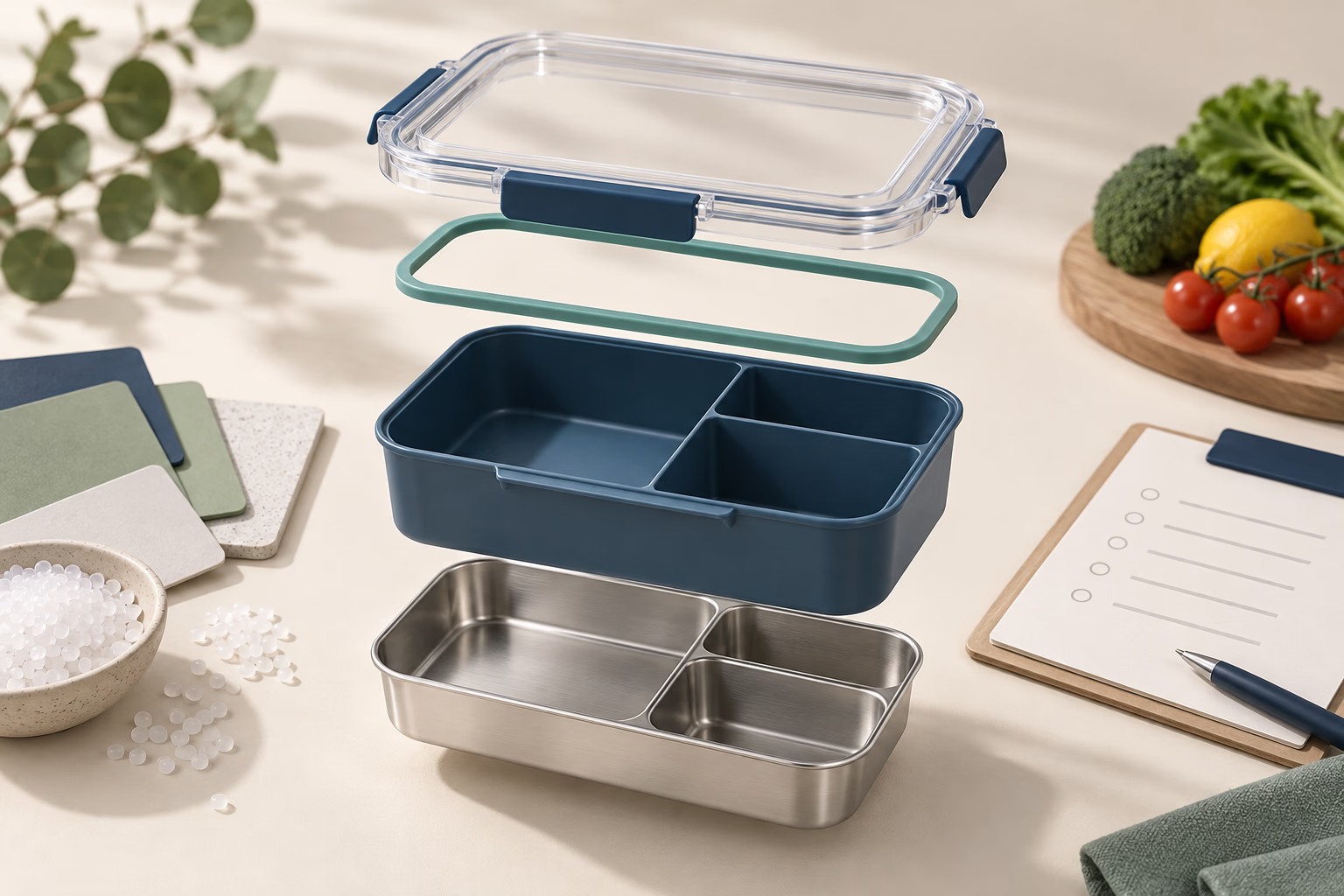
A supplier sends a report for a plain lunch-box body. Your order adds a colored lid, a seal and printed decoration. The retail artwork also introduces a microwave symbol. Before approving the order, can you connect that report to the set and instructions your customer will receive?
This is where food-contact documentation becomes a purchasing issue. A late mismatch can mean another review, a changed component or packaging that needs correcting.
“BPA-free” answers only part of the discussion. The approval file needs to describe the finished construction, its intended use and the country where it will be sold.
Why a material name is not enough
The same material description can appear on products intended for different conditions. FDA's U.S. reference tables distinguish food types and uses such as refrigerated storage and reheating in the container.[1] A document covering one use does not automatically support another.
Start with a component list. Identify the body, lid, seal, insert and relevant coatings or decoration. Then ask which evidence covers each part and the assembled product. Photographs, model references, material codes and report sample descriptions should connect the documents to the order.
For EU sales, the European Commission describes a framework covering food-contact articles, manufacturing practice and material-specific or national rules.[2] A familiar resin name alone cannot describe that whole review.
If you are still deciding which components the customer will heat or wash, settle those questions through the lunch box selection guide before approving the care icons.
“BPA-free” is a useful filter, not the whole answer
A claim about one substance does not establish the suitability of every component or use. Ask what the claim means, how it is supported and which versions it covers.
For EU buyers, Regulation (EU) 2024/3190 restricts BPA and certain other hazardous bisphenols in specified food-contact materials.[3] The distinction between a new order and qualifying older stock now matters:
- Ordinary repeat-use articles made using BPA under the old rules: their first-placement transition ended on 20 July 2026.
- Stock first placed on the market within that transition: it may remain on the market until 20 July 2027, if the transition conditions were met.[3][6]
A new purchase order is not proof of earlier market placement. Ask for the applicable legal basis and traceable stock records if a supplier relies on a transition. The separate extension for professional food-production equipment should not be applied to an ordinary consumer lunch box.[3]
These are EU provisions. U.S. review follows the applicable U.S. authorization framework: FDA explains that the regulatory status of a food-contact material depends on its constituents and intended use.[4] For other destinations, identify the national requirements separately.
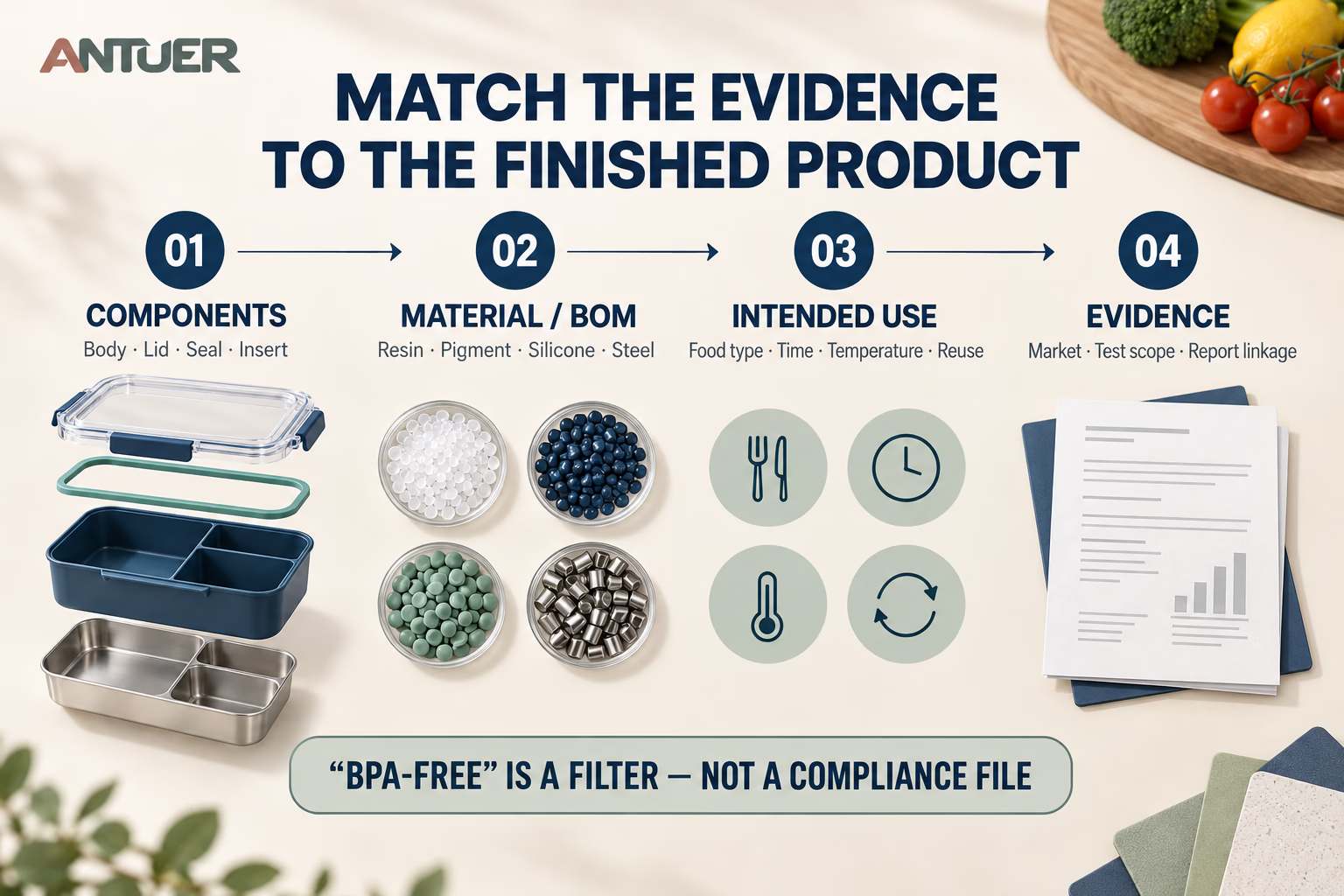
Five questions to ask before approving the order
1. Which market is the product being prepared for?
Name the destination country and sales channel in the request for quotation. Ask who will supply the required declarations, supporting records and instructions, and when they will be available.
An EU document and a U.S. assessment should each state their own basis. “Suitable for export” does not identify either one.
2. What exactly is the finished food-contact article?
Compare the ordered version against the report's sample description. Check model, components, materials, colors, decoration and any limitations.
If they differ, request a written explanation of coverage or a plan to close the gap. Do not assume every color needs a separate test, or that one report covers every color; the justification should follow the actual formulation and assessment.
3. What food and use conditions are intended?
Describe the food, contact time and temperature. Include filling, storage and reheating where relevant.
For example, if customers will refrigerate an oily meal and later heat it, identify the component used for each step and what must be removed. The laboratory can then advise the applicable assessment; the artwork team can write instructions that match it.
4. What changes after repeated use?
Agree how users will wash, dry and reuse the product. Check that the supporting review addresses those conditions and that instructions explain relevant signs of deterioration.
Regulation (EU) 2025/351 introduced repeated-use and user-information provisions for plastic articles. Its transitional stock provision concerns qualifying articles first placed on the market before 16 September 2026; this is distinct from the BPA transition above.[5] For a new EU order, ask the responsible reviewer to address the amended requirements.
5. Do the product page and package stay inside the evidence?
Check the final artwork alongside the evidence, rather than reviewing each in isolation:
| Retail statement | Question to resolve before printing |
|---|---|
| BPA-free | Which components and versions does the evidence cover? |
| Microwave-safe | Which part, under what conditions, with what removed? |
| Dishwasher-safe | Which components and care conditions are supported? |
| Reusable | What care and replacement guidance will the user receive? |
A food-contact report does not by itself demonstrate physical durability in a dishwasher or microwave. Match each claim to the relevant assessment.
Build the file from the retail promise backward
Keep one approval record linking the purchased version to its:
- component and material specification;
- intended foods and use conditions;
- applicable declarations and supporting evidence;
- care instructions and approved artwork;
- identified sample and production-change rules.
Require proposed changes to resin, pigment, seal or decoration to be reviewed before substitution. The private-label customization guide shows where to capture those decisions during sampling.
The commercial benefit is clarity
Before printing, ask: “Can we trace every important claim to the correct product and evidence, and is anyone still waiting for a document?”
ANTUER can coordinate third-party testing discussions around the agreed product and market. Share your project requirements, intended claims and available records early so the remaining questions can be included in the sampling and quotation plan.
This checklist guides procurement; product-specific conformity depends on the finished construction, intended use and applicable destination requirements.
Sources
- Food Types & Conditions of Use for Food Contact SubstancesU.S. FDA
- Food Contact MaterialsEuropean Commission
- Regulation (EU) 2024/3190, original textOfficial EU text reproduced by Spain's BOE, especially Articles 3 and 12; read with the 2026 correction below
- Determining the Regulatory Status of Components of a Food Contact MaterialU.S. FDA
- Regulation (EU) 2025/351Official EU text reproduced by Spain's BOE, repeated-use provisions and Article 4 transition
- Regulation (EU) 2026/250 correcting the BPA regulationOfficial EU text reproduced by Spain's BOE; correction to Article 12(3)
Related products
Formats to explore
Apply it to your project